The Quiet Label: Why Small UK Brands Should Stop Treating AI Imagery Disclosure as a Loophole
Photo: Gage Skidmore from Surprise, AZ, United States of America, CC BY-SA 2.0, via Wikimedia Commons
The AI imagery conversation has moved on. A couple of years ago, the debate was mostly about whether the pictures looked good enough. Now the sharper question is whether your audience knows what they are looking at, and whether they would mind if they found out later.
For small UK brands, this is not an abstract ethics seminar. It is a practical marketing problem. You may not have a legal team on call. You may work with a freelancer who uses AI tools as part of a normal workflow. You may have bought a stock image that was generated, edited or upscaled by AI without anyone mentioning it. And you may be wondering whether a label is necessary, sensible or just a bit of a vibe killer.
My view is simple: disclosure is no longer just a legal box-tick. It is a brand-trust decision. Treat it like one and the answers get much easier.
The rule is less mysterious than the internet suggests
UK advertising standards are not built around a single AI-specific rule. They are built around familiar principles: ads should not mislead, claims should be substantiated, and imagery should not create a false impression about a product, service or result. The Advertising Standards Authority has been clear that marketing communications must be obviously identifiable as marketing communications where required, and must not mislead by action, omission, ambiguity or exaggeration.
That matters because AI imagery can mislead in quiet ways. A generated model wearing your product may imply a real person used it. A generated shopfront may imply a real location. A generated before-and-after may imply a result that nobody actually achieved. The issue is not the tool. The issue is the impression the final asset creates.
Tier one: invisible and fine
There is a lot of AI imagery that needs no label at all. If the image is decorative, abstract or clearly non-evidential, a disclosure line would be noise. Think texture backgrounds, pattern fills, generic blog headers, mood-board-style social graphics, or a stylised illustration that nobody would mistake for a photograph.
This is the tier where AI is doing the same job as a stock photo or a vector shape. It sets a tone. It fills a space. It does not ask the viewer to believe anything about the product, the people or the result. For a small UK brand, this is the safest and most common use. No caption needed. No awkward asterisk. Just make sure the asset is not implying something it should not.
Tier two: use a quiet caption
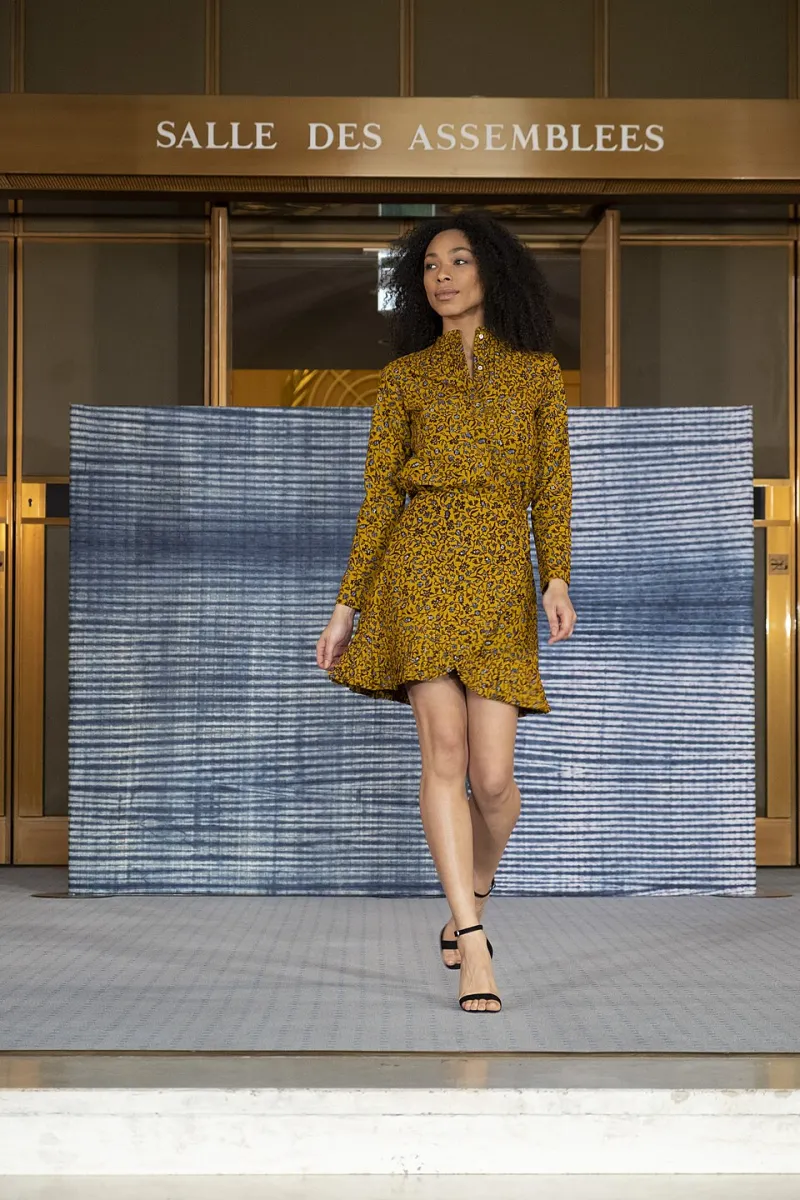
Then there is the middle ground: images that are not deliberately deceptive but could create a reasonable assumption if left unexplained. A hero image of a generic shop floor that is not your actual shop. A lifestyle shot where the model is AI-generated but the product was photographed separately. A seasonal scene that looks like a real location but is a composite. A blog image that appears documentary but is a generated approximation.
This is where a quiet caption does useful work. It does not need to be a banner. It can be a small line under the image or at the end of the post: Model image generated with AI; product photographed separately. Or: This is an illustrative image, not a photo of our actual store. The wording should be plain, specific and proportionate. The goal is not to confess everything. The goal is to prevent a false impression.
For small brands, this is often the most sensible tier. It keeps the creative flexible without asking the audience to play detective.
Tier three: the reputational risk zone
Some uses are not really about captions. They are about whether the image should exist at all. If the visual is doing evidential heavy lifting, AI generation is a reputational risk even if you label it.
Examples include before-and-after skin or hair results, customer testimonial portraits, staff photos presented as real people, food photography that implies a real portion size, property interiors that imply a real listing, or product-in-use shots where the performance of the product is the point. A caption may technically clarify things, but the bigger problem is that the campaign is built on an image that cannot support the claim.
This is where small UK brands need to be honest with themselves. If the image is the proof, a label is not a fix. Use a real photo, a real customer, a real result or a clearly illustrative treatment that does not pretend to be evidence. That is not a legalistic point. It is a trust point. Once an audience feels fooled, they rarely remember the small print.
Why small brands get caught out
The risk is not usually malice. It is workflow. A freelancer delivers a set of assets. A stock subscription includes AI-generated files. A social template app adds a generated background. A product photo is retouched with generative fill. Nobody writes a memo. The campaign goes live. Then someone in the comments asks a simple question: is this real?
For a small brand without a legal team, the answer should be easy to find. Keep a simple record of where images come from. Ask your freelancer directly whether AI was used and how. Do not assume metadata will travel with the file; it often does not. And when in doubt, choose the clearer option. A quiet caption is cheaper than a defensive reply thread.
A label is not a weakness
The fear is that labelling AI imagery makes a small brand look cheap or untrustworthy. I think the opposite is more likely. In 2026, audiences are increasingly fluent in AI visuals. They can spot the odd hand, the too-smooth skin, the suspiciously perfect lighting. What damages trust is not the use of the tool. It is the sense that the brand tried to hide it.
A proportionate label says something useful: we know what we are doing, we are not trying to pull the wool over your eyes, and we respect your ability to make up your own mind. That is a better brand signal than pretending every image is a documentary photograph.
So stop treating disclosure as a loophole to be argued. Treat it as a filter. Does this image need a label? Does it need a different image? Or is it fine as it is? Most of the time, the honest answer is also the simplest one.